How to Get Paid in Kenya: Invoicing, Debt Recovery and the Small Claims Court
Build a clear invoice trail, follow up overdue accounts and choose an appropriate recovery route, including Small Claims Court.
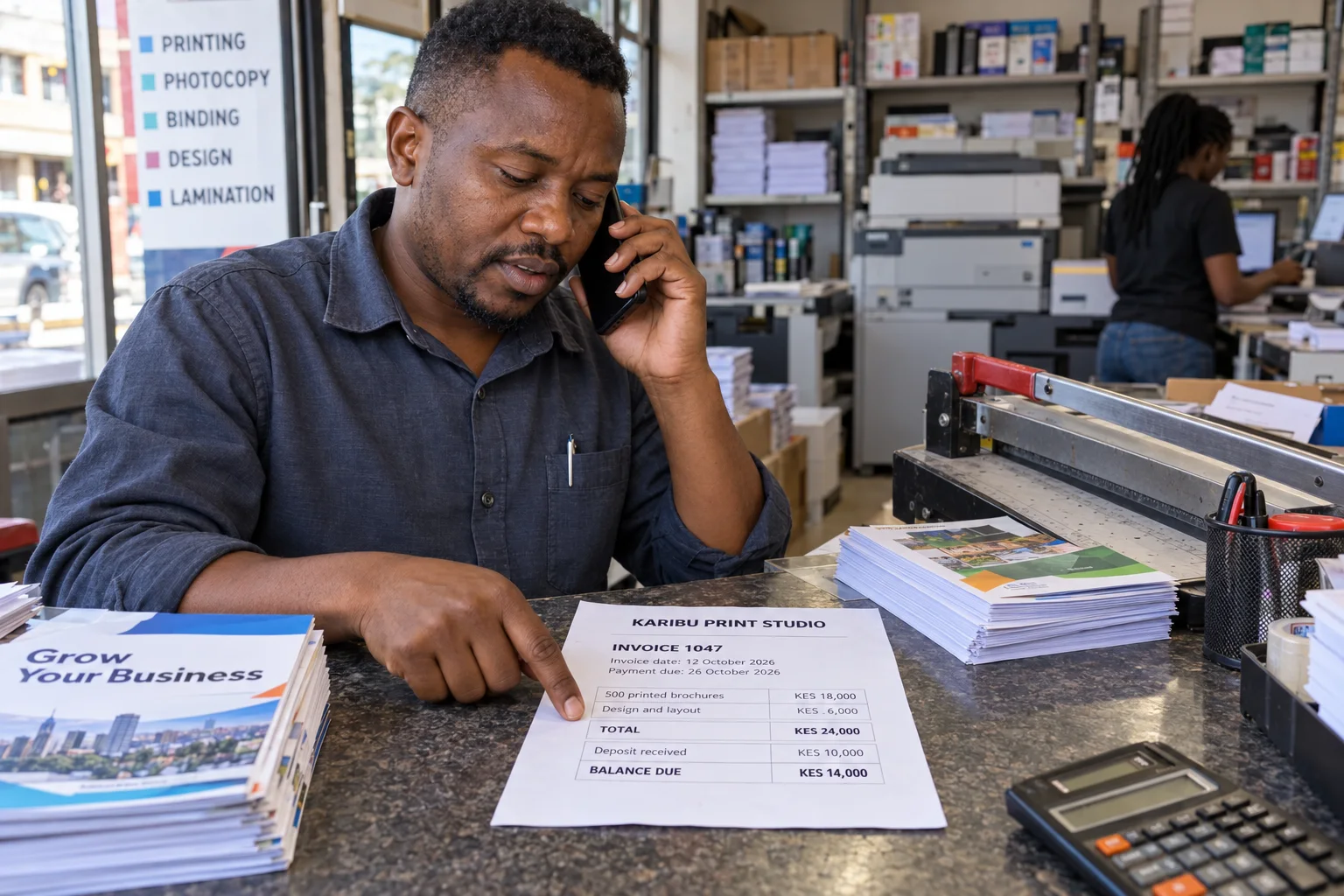
A late invoice can become a collection problem in stages: the due date passes, follow-up goes unanswered, and the customer may dispute what is owed. Keeping a record at each stage helps you choose the next step.
Small Claims Court: Key facts
- What can the Small Claims Court hear? Claims on a contract for goods or services, money held and received, damage to property, personal injury, and counterclaims, up to KES 1,000,000.
- How long do I have to sue? Six years from the date the debt fell due.
- What does it cost to file? Filing fees range from KES 200 to KES 1,000, depending on the claim value. Confirm the applicable fee with the registry.
- Do I need a lawyer? No. You can appear in person, through a close relative, or through an advocate whose fees the Chief Justice regulates.
- How long does it take? The court must determine the claim within sixty days of filing.
- My debt is bigger than KES 1,000,000. What now? You can abandon the excess to bring it within the limit, or file in the Magistrate's Court.
1. Why the paperwork decides who gets paid
A customer who owes you money has three questions to answer before paying: do I owe it, how much is it, and when was it due. If your records answer all three, most customers pay. If they do not, you have handed them a reason to stall.
That is why the paperwork does most of the work. A written term, a clear invoice and a clean record settle more disputes than any letter. The court is there for the cases that paperwork did not close.
2. What a proper invoice must carry
An invoice proves what you sold, to whom, and for how much. When it is vague, the customer has room to stall.
If you are registered for VAT, the law requires a tax invoice with prescribed details when you make a taxable supply. In practice that means the seller's name and PIN, the buyer's name and PIN (required where the buyer intends to claim the expense or the input tax), a serial invoice number, the date, a description of the goods or services, the quantity, the price, the VAT rate and the VAT amount, and the total.
Since 2024, the Kenya Revenue Authority requires businesses to issue invoices through the electronic Tax Invoice Management System, eTIMS. The duty covers every person carrying on business, whether or not they are registered for VAT. Two costs follow. A customer who is VAT-registered cannot claim input VAT on an invoice that misses the eTIMS rules. And from 1 January 2024, a business expense that is not supported by an eTIMS invoice is not deductible for income tax, under section 16(1)(c) of the Income Tax Act. KRA has exempted certain expenses from that validation, and there is a manual route for eligible business expenses that a TIMS/eTIMS invoice does not support, provided the expense was wholly incurred to generate taxable income. Both land on your customer, which gives them one more reason to sit on your invoice until it is fixed, so it pays to get it right the first time.
If you are not registered for VAT, the eTIMS duty still applies to you, and your customer's income tax deduction usually depends on it, so issue the electronic invoice the same way. Your paper invoice still needs the same fields, minus the VAT lines, plus your payment terms and the date payment is due. The buyer's PIN is required only where the buyer intends to claim the expense or the input tax.
3. Setting payment terms you can enforce
Payment terms are the thing you enforce later.
| Term | What it does |
|---|---|
| Deposit before work | Covers your material cost if the customer disappears |
| Milestone payments | Keeps cash moving on long jobs instead of one lump at the end |
| Payment due on delivery | Shortens the gap between sale and cash |
| Net 30 | Gives a business customer time to process, with a fixed due date |
| Late payment interest | Adds a written cost to delay, which you can claim if you sue |
Two rules make terms work. Put them in writing before you start, and repeat them on every invoice. A term that only ever existed in a phone call is a term you will struggle to prove.
4. The paper trail that wins a claim
The Small Claims Court is not bound by the strict rules of evidence that apply in the higher courts. It can accept oral testimony, written records and documents. That helps you, and it rewards anyone who kept records.
Keep these, because each one answers a question the debtor will raise:
- a signed order, quotation acceptance or contract;
- the invoice and proof it was delivered, such as an email or a WhatsApp message;
- delivery notes signed on receipt;
- M-Pesa or bank records showing part payment, which support your claim that the debt existed;
- your follow-up messages, which show the date the payment was chased.
An M-Pesa statement showing a partial payment is powerful: it supports your claim and is hard for a customer to deny. It does not by itself prove the whole amount you are claiming, so keep the invoice and the delivery records as well.
5. Chasing the debt without going to court
Many debts are collected at this stage, without going to court.
Start with a friendly reminder close to the due date, then a firm one, then a formal letter of demand. A demand letter states the amount, the basis of the debt, the due date, and a final deadline before you file. Give a short, fixed window, and keep a copy.
If your contract sets late payment interest, state it in the demand. If it does not, ask for the principal and let the court handle interest on any judgment.
Keep every message. A file of unanswered reminders is itself evidence that you tried to resolve the matter before suing, which courts expect.
6. The Small Claims Court: what it can hear
The Small Claims Court was created by the Small Claims Court Act, which came into force in April 2016 and was amended in 2020. It sits as a subordinate court and is meant to be within reach in every sub-county.
It hears civil claims on:
- a contract for the sale and supply of goods or services;
- a contract relating to money held and received;
- loss or damage to property, or the delivery and recovery of movable property;
- compensation for personal injuries;
- a set-off or counterclaim under any contract.
The limit is KES 1,000,000. A few matters are excluded: defamation, libel, slander, malicious prosecution, disputes over title to or possession of land, and employment and labour relations. You also cannot split one large claim into several small ones to fit the limit.
If your claim is worth more than KES 1,000,000, you have two choices. You can abandon the excess and claim the maximum here, or file in the Magistrate's Court. If you abandon the excess, you give up that part; you cannot later sue for it separately (Small Claims Court Rules, rule 3(6)).
7. Filing a claim: where, how, and what it costs
File at the court nearest to where the transaction took place, or where the respondent lives or carries on business.
The claim starts with a Statement of Claim in the prescribed form, filed at the registry with the fee. It can also be presented orally, and it can be filed electronically. You then serve the claim on the respondent. If you do not serve it within six months, the claim is treated as abandoned, though it can be reinstated once (Small Claims Court Rules, rule 7(3)). The court will not reinstate a claim arising from a contract entered into more than six years before the application, or one relating to an accident more than three years before it (rule 7(4)).
The respondent has fifteen days to file a response under the Act, while the Rules set fourteen days for a respondent within the local limits and thirty days for one outside them. Follow the served court notice and confirm the deadline with the registry. If no response comes, the court can enter judgment in your favour. Once the case is running, the court must determine it within sixty days of filing.
Filing fees
| Value of the claim | Filing fee |
|---|---|
| Less than KES 200,000 | KES 200 |
| More than KES 200,000 but less than KES 500,000 | KES 400 |
| More than KES 500,000 but less than KES 800,000 | KES 600 |
| More than KES 800,000 but less than KES 1,000,000 | KES 1,000 |
Service fees
| Distance to the respondent | Service fee |
|---|---|
| Up to 2 km | KES 100 |
| 2 to 10 km | KES 300 |
| Over 10 km | KES 500 |
Fees change, so confirm the current schedule at the registry before you file. The published bands use "more than… but less than…", so for a claim exactly on a boundary confirm the fee with the registry.
You do not need a lawyer. A party can appear in person, through a duly authorised representative, usually a close relative, or through an advocate. Since the 2020 amendment advocates may appear, and their fees are regulated by the Chief Justice. The court may also refer the matter to mediation or another form of alternative dispute resolution with the parties' consent.
8. What happens after judgment
A judgment in your favour is an order to pay. It can require a lump sum or instalments. If the debtor still does not pay, you can enforce it: the court can order attachment and sale of movable or immovable property, or the attachment of the debtor's salary. Enforcement adds cost: the fees recoverable on execution of a decree do not exceed ten per cent of the aggregate value of the subject matter, together with disbursements (Small Claims Court Rules, fee schedule, item 8).
If either side is unhappy with the decision, an appeal lies to the High Court on matters of law only, and the High Court's decision is final. On costs, the court may order the losing party to pay the winner's costs, or it may leave each side to carry its own.
9. The six-year clock
A contract debt must be sued on within six years of the date it fell due, under the Limitation of Actions Act. Miss that window and the debt becomes hard to enforce. The six years can restart: a written and signed acknowledgment of the claim, or a payment towards it, gives the right of action a fresh accrual from that date (sections 23(3) and 24(1)).
The clock is why a slow chase is a losing chase. Every month you wait moves you closer to a debt you can no longer recover in court. If you intend to claim, keep the file moving.
10. When to cut your losses
Not every debt is worth chasing. A KES 5,000 debt against a customer you cannot find will cost more in time and fees than it is worth. Set a rule for yourself: a threshold below which you write it off, and a hard point at which you either demand or file.
Writing off a bad debt is part of the cost of selling on credit, and it is usually cheaper than chasing it forever.
11. Cautions before you sue
Before you file, check three things. The debt is within the six-year window. The respondent is someone the court can reach. And the amount is one the court can hear. If the respondent has vanished and has no assets, a judgment you cannot enforce is a piece of paper.
Where the customer is still trading and wants to keep the relationship, a firm demand letter usually beats a filing. The court is there for the cases that demand letters do not close.
Key facts
| Rule | Period or figure | Source |
|---|---|---|
| Pecuniary limit | KES 1,000,000 | Small Claims Court Act, Cap 10A, section 12 |
| Matters the court cannot hear | Defamation, libel, slander, malicious prosecution, disputes over title to or possession of land, employment and labour relations | Small Claims Court Act, section 13(5) |
| Respondent's response | 15 days under the Act; the Rules set 14 days locally and 30 days outside | Small Claims Court Act, section 25(2); Small Claims Court Rules, rule 9(2) |
| Determination | Within 60 days of filing | Small Claims Court Act, section 34(1) |
| Appeal | To the High Court, on matters of law only; the High Court's decision is final | Small Claims Court Act, section 38 |
| Service deadline | 6 months, or the claim is treated as abandoned; reinstatement once, subject to rule 7(4) | Small Claims Court Rules, 2019, rule 7 |
| Filing fees | 200 / 400 / 600 / 1,000 by claim value | Small Claims Court Rules, 2019, Second Schedule |
| Service fees | 100 within 2 km, 300 up to 10 km, 500 over 10 km | Small Claims Court Rules, 2019, Second Schedule |
| Costs | The successful party may be awarded costs; otherwise each side bears its own | Small Claims Court Act, section 33 |
| Limitation | 6 years for a contract claim from the date it fell due | Limitation of Actions Act, section 4(1)(a) |
| Tax invoice | Prescribed details required for a taxable supply | Value Added Tax Act, 2013 (Cap. 476), section 42 |
| eTIMS | Every person carrying on business must issue electronic tax invoices; an expense without one is not deductible, subject to the exempted expenses and the manual route for eligible unsupported expenses | Tax Procedures Act, section 23A; Income Tax Act, section 16(1)(c) |
Frequently Asked Questions
What is the maximum I can claim in the Small Claims Court in Kenya?
KES 1,000,000. If your claim is larger, you can abandon the excess and claim the maximum, or file in the Magistrate's Court. Abandoning the excess gives up that part, and you cannot later sue for it separately (Small Claims Court Rules, rule 3(6)).
Do I need a lawyer for the Small Claims Court?
No. You can appear in person, through a duly authorised representative such as a close relative, or through an advocate whose fees are regulated by the Chief Justice.
How much does it cost to file a small claim?
Filing fees range from KES 200 to KES 1,000, depending on the claim value. Confirm the applicable fee with the registry. Service fees run from KES 100 depending on the distance to the respondent.
How long does a small claim take?
The court must determine the claim within sixty days of filing, though actual proceedings can run longer. The respondent has fifteen days to respond, and a claim not served within six months is treated as abandoned.
How long do I have to recover a debt in Kenya?
Six years from the date the debt fell due, under the Limitation of Actions Act. After that the debt is generally unenforceable in court.
Can I sue for a debt with no written contract?
Yes. The court is not bound by strict rules of evidence and can accept oral testimony, records and documents. M-Pesa statements, delivery notes and messages all help.
What happens if the debtor does not pay after judgment?
You can apply to enforce the judgment. The court can order the attachment and sale of property, or the attachment of the debtor's salary.
Can I claim interest on a late payment?
If your contract sets late payment interest, claim it. If it does not, you can ask the court for interest on the judgment.
Where do I file a small claim?
At the court nearest to where the transaction took place, or where the respondent lives or carries on business.
Sources and review record
Sources in this guide were checked on 28 October 2026. Official details can change.
- Small Claims Court Act, Cap 10A (No. 2 of 2016), jurisdiction, limits, filing, determination and enforcement: Kenya Law
- Small Claims Court Rules, 2019 (Legal Notice 145 of 2019), filing, service, response and fees: Kenya Law
- Limitation of Actions Act, Cap 22, section 4, six-year limit on contract claims: Kenya Law
- Value Added Tax Act, 2013 (Cap. 476), section 42, tax invoices: Kenya Law
- Tax Procedures Act, Cap. 469B (No. 29 of 2015), section 23A, electronic tax invoices: Kenya Law
- Income Tax Act, Cap. 470, section 16(1)(c), business expense deductibility: Kenya Law
- Kenya Revenue Authority, electronic Tax Invoice Management System (eTIMS): kra.go.ke
Stay updated
 Stay updated
Get the next guide in your inbox.