A Weekly Cash-Flow Forecast for a Kenyan Small Business
A weekly cash-flow forecast helps you see when cash may arrive and when payments fall due. It is a forward-looking planning worksheet, not a substitute for accounting or tax records and not a promise that financing will be available.
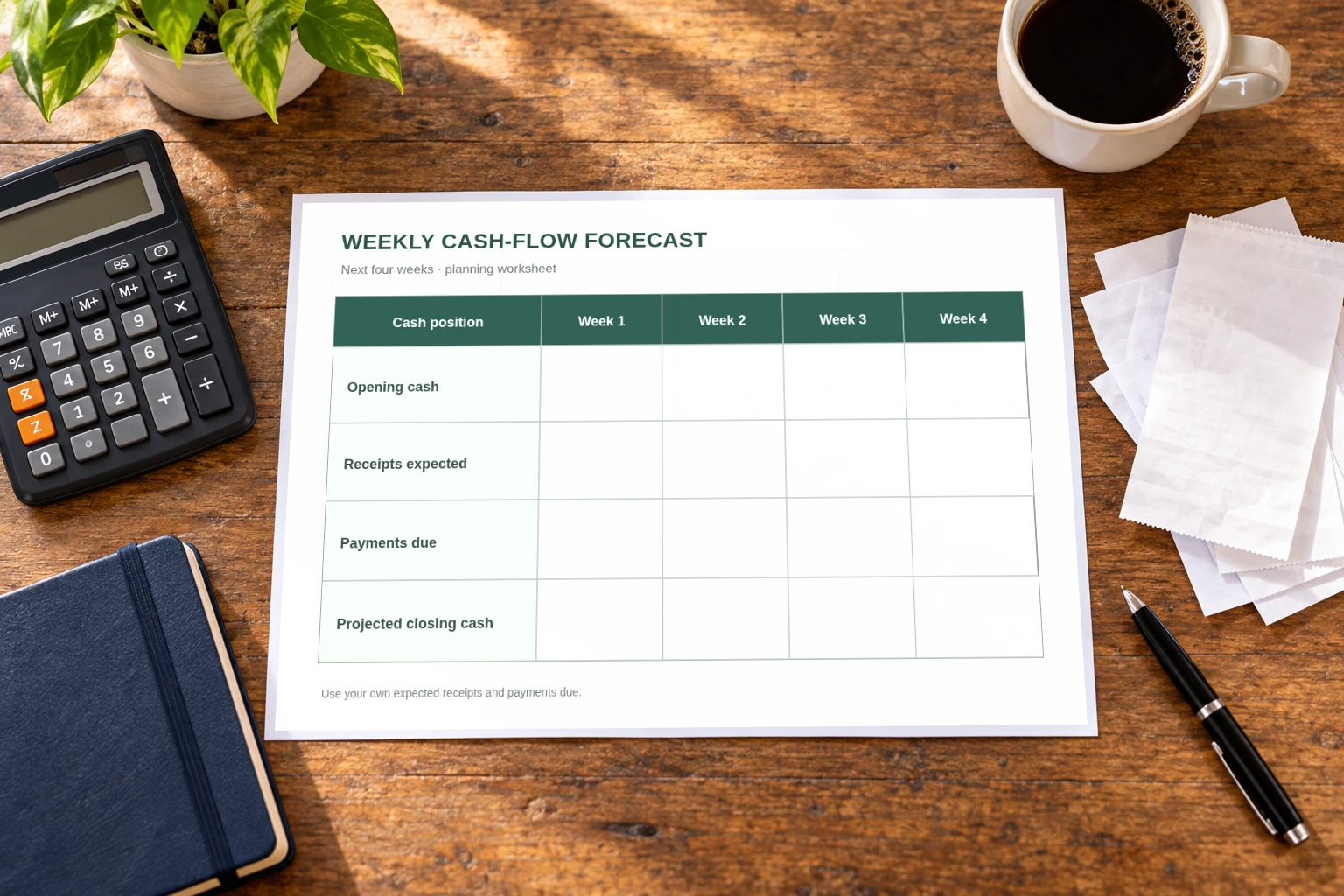
Start with the next four weeks. If your customers or suppliers work on longer payment cycles, extend the view. Update it once a week using what actually happened.
Build the forecast
Copyable four-week worksheet
| Cash item | Week 1 | Week 2 | Week 3 | Week 4 |
|---|---|---|---|---|
| Opening cash | ________ | ________ | ________ | ________ |
| Receipts expected | ________ | ________ | ________ | ________ |
| Payments due | ________ | ________ | ________ | ________ |
| Projected closing cash | ________ | ________ | ________ | ________ |
- Start with cash you can actually use. Record the opening balance in the business bank account, till/paybill settlement balance, mobile-money wallet and cash box. Do not count a transfer between your own accounts as new income.
- List expected receipts by likely arrival date. Include customer invoices only in the week you realistically expect payment. Put disputed or uncertain receipts in a separate note until you have a credible date.
- List payments by due date. Include suppliers, stock, payroll, rent, utilities, loan repayments and statutory payments that are actually due. Separate essential commitments from optional spending.
- Calculate the projected closing balance: opening cash + receipts expected − payments due.
- Set a minimum balance for your own business. Base it on commitments you need to protect; do not copy someone else’s number as a universal rule.
Carry forward: use each week’s closing balance as the next week’s opening balance. This keeps the forecast continuous; a transfer between your own accounts is not a new receipt.
| Illustrative Week 1 | KES |
|---|---|
| Opening cash | 80,000 |
| Receipts expected | 40,000 |
| Payments due | 75,000 |
| Projected closing cash | 45,000 |
These figures are invented to show the arithmetic, not a Kenyan business benchmark. If the KES 40,000 receipt is delayed, the closing balance becomes KES 5,000. If this business has chosen a KES 25,000 minimum balance, it would be KES 20,000 below its own floor. The example does not recommend a particular reserve amount.
If a week looks tight
Act before the shortfall arrives. Confirm the customer’s payment date and follow up on a correct invoice. Speak to a supplier early about timing. Pause purchases that are not necessary for the next cycle. If you consider borrowing, compare the total cost and repayment date, and include repayments in the forecast; do not count an unapproved loan as cash.
Make it a weekly habit
At the end of each week, replace forecasts with actual receipts and payments. Note why an amount arrived early, late or not at all, then roll the remaining weeks forward. The purpose is not to predict perfectly; it is to spot a cash gap early enough to choose a response.
Keep this forecast beside your accounting records, not in place of them. All amounts above are examples only; no market averages, loan rates or tax deadlines are being asserted.
Frequently Asked Questions
What is a weekly cash-flow forecast?
It estimates available cash, expected receipts and payments due over coming weeks. It can reveal a possible cash gap but does not guarantee that receipts or finance will arrive.
How do I carry the balance into the next week?
Use the previous week’s projected closing cash as the next week’s opening cash, then add expected receipts and subtract payments due.
Is the KES 25,000 reserve a recommended amount?
No. It is an invented example of a floor chosen by that hypothetical business, not a benchmark or recommendation for every business.
Sources and review record
The claims in this article were checked on 12 October 2026. Official portal details may change.
- IFRS Foundation — IAS 7 Statement of Cash Flows (checked 2026-10-12)
Stay updated
 Stay updated
Get the next guide in your inbox.