What Kenyan entrepreneurs should know before applying for a business grant
NYOTA, TEF and WIDU: compare eligibility, funding, matching contributions, application windows and the work a grant requires.
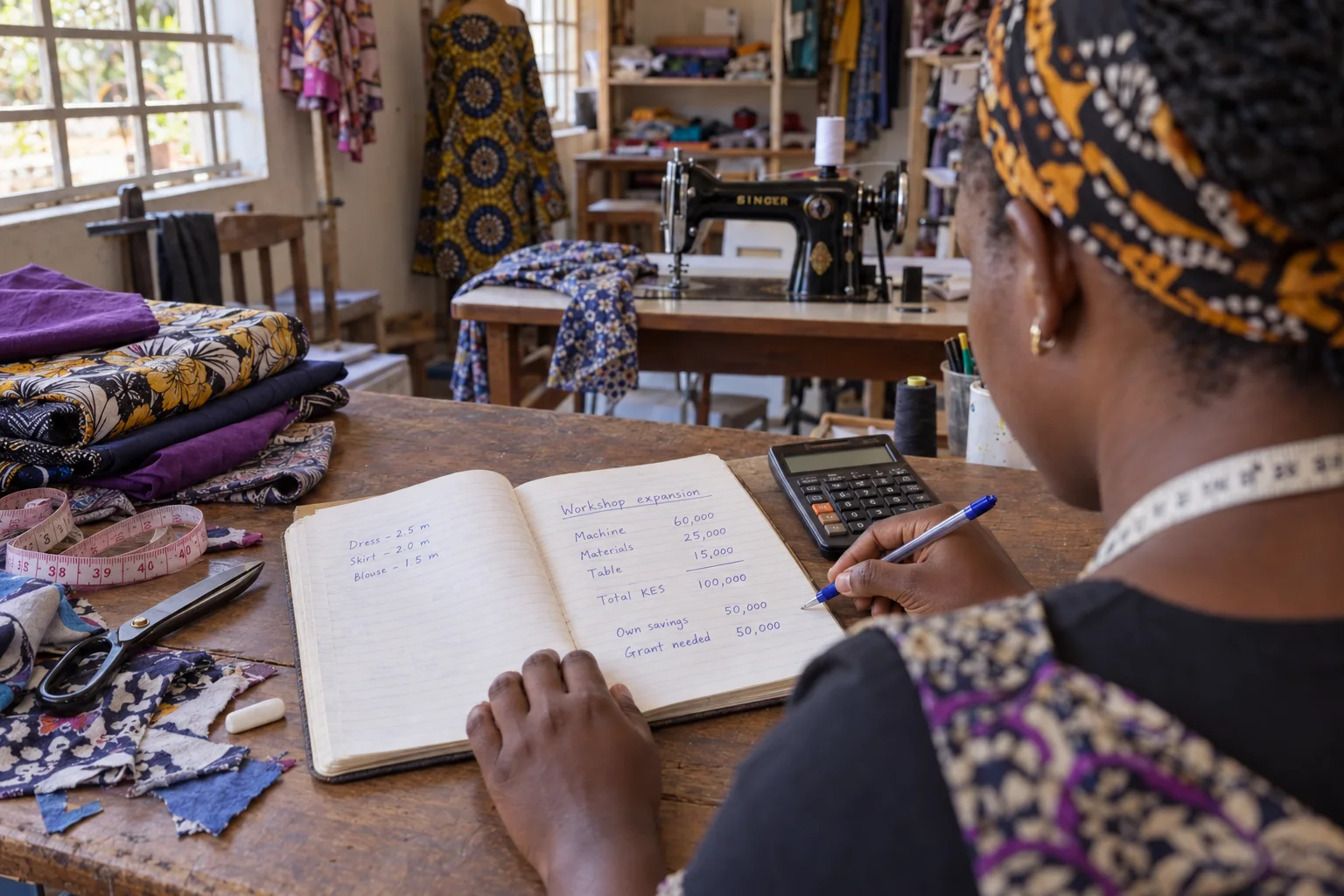
Every few weeks, someone in Kenya is told there is free money for small businesses. Sometimes it arrives as a WhatsApp forward. Sometimes it is a friend who knows a person at the county office. Sometimes it is an advert with a photograph of a very large cheque.
Most of that money either does not exist or turns out to be a loan with a fee attached. A real grant is different. It is money given to do a specific thing, and it does not have to be repaid. It is also small, competitive and slow. NYOTA pays KES 50,000. The Tony Elumelu Foundation pays US$5,000 to a small number of Africans each year. The Original WIDU Grant matches up to EUR 3,000 on a first application, and up to EUR 5,000 later, but only if you have a relative or friend in the EU, Switzerland or Norway putting money in beside it.
The question worth asking is not whether you can get a grant. It is whether a grant fits what your business needs this year, and whether you can live with its terms if you win.
What to know before applying
- Is a grant really free? You never repay the money. You pay in application time, restricted spending, matching funds and reporting.
- Does the Kenyan government give grants to SMEs? Rarely. Uwezo Fund, YEDF, WEF and KIE all lend. NYOTA is the main non-repayable youth capital, at KES 50,000.
- Who qualifies for NYOTA? Kenyan youth aged 18 to 29, or up to 35 for persons with disabilities. Form Four or below. Unemployed, underemployed or in low-income work. Apply free on *254#.
- How long does a grant take? Months, not weeks, from application to disbursement. If you need the money this month, a grant will arrive after the crisis, not during it.
- Will anyone ask me for money? A legitimate grant programme will not charge a registration, application, processing or "unlocking" fee. A matching grant may require your own contribution, and a loan may carry published charges; those are different from a fee to access a grant.
1. What a grant is, and what it costs you
A grant is money awarded to accomplish a specific goal set out in the programme guidelines. A government, a development partner, a foundation or a company gives it, and you do not pay it back. That is the appeal. The catch is that the funder sets the rules, and the rules reach into how you run the business: the money stays tied to what you said you would spend it on, and changing that takes a variation request and time.
Three rules come with almost every grant. The money is tied to a purpose, so spending it elsewhere can mean refunding it. Selection is competitive or randomised, which means meeting the criteria gets you into the room but not through the door. And the money comes with work attached after it lands: receipts, reports, sometimes a visit, and for larger awards audited accounts.
First-time applicants usually plan for the money and forget the work. The interest rate is zero. Everything else has a price.
Time. A serious application is a small project of its own. You check eligibility, write a concept note, build a budget, gather documents, and often sit through training or an assessment before any money moves. Those hours are not paid, and every one of them is an hour you were not selling.
Freedom. Grant money is line-item money. If a supplier fails or a machine breaks, you cannot move the funds and carry on. In a market that changes as fast as ours, that is an operating risk, not a technicality.
Paperwork. Receipts, progress updates, financial statements, and for bigger awards an external audit. If your bookkeeping is already shaky, a grant will not fix it. The reporting calendar is set by your agreement, and missing it can block the next payment.
Matching money. Some programmes want you to contribute, and many of those pay in arrears: you spend first, submit receipts, then get reimbursed. That model assumes you can carry the whole project on your own balance sheet. If you cannot, the grant is not real money for you yet.
Dependence. A grant that funds most of your growth makes the business depend on a decision you do not control. When the programme closes, the capital stops. The reporting does not: final reports, record retention and audit obligations can continue. Decide now what the business looks like the month after the last tranche.
2. Five checks before you apply
Eligibility is the floor. These five questions decide whether applying is worth your time.
Does the project match what the funder says it wants?
Reviewers score against the programme's purpose, its target group and its geography. Use the funder's own words. If the call says youth empowerment in informal settlements, write about youth empowerment in informal settlements, and show how your business fits. Translating their priorities into your marketing language loses marks you never see.
Can your business survive the wait?
Grants are slow by design. Application to disbursement usually runs into months, and some programmes take longer. If you need working capital this month, a grant will not reach you in time. Keep running the business on the cash you already have.
Can you carry the reporting?
Name the person. If it is you, and you already file your KRA returns late, fix that habit before you apply. A dedicated accountant or a well-structured bookkeeping system handles receipts and the reports your agreement asks for. Without one, the administrative cost can derail daily operations.
Can you raise the required contribution?
Ask directly whether the grant is reimbursement-based, and what proof of capacity they want: a bank statement, an approved facility, a deposit. Get the answer in writing before you build a budget around it. Never borrow at an expensive rate just to qualify.
Can you spend the money exactly as agreed?
Read the allowable costs line by line against what the business actually needs. If your real gap is stock or working capital and the grant only buys equipment, you will end up with a machine and no money to run it.
If the answer to the second, third or fifth question is no, stop here. Applying will cost you weeks and return nothing.
3. The grants that actually exist in Kenya
In Kenya, there are grants and resources for small businesses financed by different grant providers. These are three programmes worth understanding. Other genuine enterprise grants exist, including KJET's cluster co-investment grant, where the cluster must match at least half the project cost in cash, and the FAO PLACE SME Grant Facility, an EU-funded programme offering milestone-based matching grants to registered SMEs in pastoral value chains, capped at fewer than 20 full-time staff and turnover below USD 100,000, but their eligibility is narrower and their rounds open and close. Many offers advertised as a grant are not: they are loans, competition prizes, or somebody selling access to one of these.
| Programme | What it pays | Who qualifies | How to apply | Status at 28 October 2026 |
|---|---|---|---|---|
| NYOTA (National Youth Opportunities Towards Advancement) | KES 50,000 in total, paid as two tranches of KES 25,000. Each tranche is KES 22,000 to your Pochi la Biashara wallet and KES 3,000 to NSSF Haba Haba savings | Kenyan citizen, 18 to 29 (up to 35 for persons with disabilities), Form Four or below, unemployed, underemployed or in low-income work, national ID and a SIM registered in your own name | Free USSD application on *254#. Help at county or sub-county youth offices and MSEA offices | Tranche two concluded nationwide in July 2026. Applications for all components are currently closed. Free at every stage |
| Tony Elumelu Foundation Entrepreneurship Programme | US$5,000 non-returnable seed capital, plus training, mentorship and network access | African, 18 and above, with a business idea or an early-stage registered business. TEF's terms describe a business age of 0 to 3 years; its own FAQ says no more than 5 years. Confirm the cutoff that applies to the cycle you are entering | TEFConnect (tefconnect.com) | The 2026 window ran 1 January to 1 March and is closed. TEF's terms describe an annual 1 January to 1 March window; confirm the next cycle on TEFConnect. Funding follows the required training, business-plan and documentation checks |
| WIDU Kenya (GIZ, co-financed by the European Union and the Gates Foundation) | Up to EUR 3,000 on a first application, up to EUR 5,000 on the second and third, plus three coaching sessions | Micro and small businesses in Kenya, any sector, up to 20 employees, sponsored by a relative or friend in the EU, Switzerland or Norway. You must be based in Kenya; WIDU pays the grant to your mobile banking number or bank account | Direct application at widu.africa. The diaspora donor registers first and invites you | Open on the platform, and it is the only one of the three currently accepting applications. You and the donor each put in between EUR 150 and EUR 1,500; WIDU matches that combined amount with a grant of EUR 300 to EUR 3,000 |
Current call and eligibility checks. FAO’s cited PLACE round closed on 7 August 2026; watch for a new official call. WIDU’s FAQ says fewer than 20 employees, while its grant contract says not more than 20. If your business has exactly 20, ask WIDU to confirm eligibility before applying.
NYOTA payment detail. Each tranche has its own conditions. You complete Business Development Services (BDS) 1 before the first KES 25,000, then two mentorship sessions and BDS 2 before the second. The project targets 820,000 young people across all 47 counties who are unemployed, underemployed or in low-income work. A separate OJE component has equipped more than 100,000 youth with soft skills. The KES 3,000 in each tranche that goes to NSSF Haba Haba is savings, not cash in your business wallet. NYOTA splits savings into 30% short-term and 70% long-term, and the short-term portion can be accessed one year after you opt in. Do not budget the whole KES 25,000 as money you can spend. A beneficiary can take part in only one NYOTA intervention, and the project says further application windows may be announced through its official channels.
WIDU matching detail. The first round works on a 25:25:50 model: you and your diaspora donor each contribute the same amount, between EUR 150 and EUR 1,500, and WIDU matches the combined investment with a grant of EUR 300 to EUR 3,000. Later rounds use an equal 1:1:1 model: each of you contributes the same amount, between EUR 500 and EUR 5,000, and WIDU matches it with a grant of up to EUR 5,000. That EUR 5,000 is the grant ceiling, not the project total: a later-round project can reach EUR 15,000. This is matching support, not a grant with no contribution. WIDU cannot accept a project without a donor. The order matters: you spend your own and your donor's contributions first and upload invoices and receipts to the platform, a coach verifies those investments, and only then does WIDU approve and pay 90% of its grant, with the final 10% following your documentation of the grant spending. You do not have to finance the whole project yourself before any grant money arrives, but you do have to front and document your own and your donor's share first.
What is not a grant. These four are named as grants all the time. They are loans, and budgeting for them as free money will wreck your cash flow:
- Uwezo Fund: constituency group loans. Wezesha lends KES 50,000 to 100,000 for first-time borrowers; Endeleza lends 150 to 200 per cent of the first loan, capped at KES 500,000.
- Youth Enterprise Development Fund (YEDF): youth loans. Vuka goes up to KES 5,000,000, repayable over 1 to 5 years depending on the amount. YEDF's product page quotes 8% annually; its 2017 brochure quotes 6% plus a 1% management fee, and the Fund's board report records the rate being lowered from 8% to 6% from June 2017. Confirm the current rate, fees and total repayment in the written offer.
- Women Enterprise Fund (WEF): Tuinuke group loans of KES 100,000 in the first cycle, rising to KES 750,000 by the fifth, with a 6% administration fee charged upfront.
- Kenya Industrial Estates (KIE): loans for machinery, equipment and working capital. KIE's current homepage advertises SME loans of KES 100,000 to 20,000,000 over up to 84 months, while its lending page lists a narrower SME band of KES 500,000 to 14,000,000 over 3 to 8 years. Micro loans, for youth and women's groups and Jua Kali operators, run KES 10,000 to 500,000. Confirm the current offer in writing.
Repayment terms sit in the written offer, so ask for it. Fees on these schemes are set by each fund and change, so confirm the current written offer before you sign anything.
4. When a loan is the better answer
A grant is a different instrument from a loan, and for some situations it is the wrong one.
Take the loan when you need the money now. Mobile and bank credit can move in days. The funds you would reach for here, YEDF and Uwezo, do not: they run on a fund calendar too. A grant moves on the funder's calendar, and the calendar is not yours.
Take the loan when you need to decide where the money goes. Stock, wages, rent, fuel, a deposit on premises. A grant may allow some of these within its published cost rules, but you do not choose: the funder's approved budget does. That gap between an allowable-costs list and your actual needs leaves the business short of working cash after the grant lands.
A loan makes more sense when you fall outside the current priorities. If your sector or your county is not in the call, the application dies on page one, however well written it is.
Take the loan when you can service a repayment schedule but cannot carry a year of reporting obligations. A known instalment is a simpler obligation than a variation request.
Borrowing also builds a record. Repaying on time opens larger facilities later. A grant leaves you with a reporting history, which does not carry the same weight with lenders as a repayment record.
One workable order for a micro-business is savings first, then chama or supplier credit, then a small YEDF or Uwezo facility repaid on time, and grants as a competitive bonus somewhere along the way. It depends on what you are eligible for, what each costs, and what you can repay. Grants reward businesses that are already steady. They rarely make an unsteady one steady.
5. What to prepare
Applications in Kenya ask for a similar set of things, but there is no single list that every call uses. Follow the programme's own checklist and build the file once so you can reuse it.
| Document | What it proves | Where it comes from | Watch out for |
|---|---|---|---|
| National ID | Identity and citizenship | Registrar of Persons | The name must match your KRA PIN and bank account exactly |
| KRA PIN certificate | You are registered for tax | iTax | A sole proprietor uses their personal PIN |
| Tax Compliance Certificate (TCC) | You have filed and paid what is due | iTax | Valid 12 months. Not every grant call asks for one |
| Business registration certificate | The entity exists | BRS through eCitizen | Business name or company |
| Group registration certificate | The group exists | The body the fund accepts: the Directorate of Social Development for self-help groups and CBOs, the Registrar of Societies, or MSEA, which WEF accepts | Needed for Uwezo, WEF and YEDF group loans |
| Bank account in the entity or group name | The money can be paid and traced | Your bank | Statements are usually requested too |
| Business plan and budget | The money has a purpose | You | Use the funder's template and line items |
| Proof of matching funds | You can carry your share | Bank statement, approved facility, deposit | Ask what proof the funder accepts before you apply |
A missing document stops an application just as surely as a weak idea does. Start from the checklist in the call you are answering, not from this table: a USSD application like NYOTA's does not ask for a TCC at all, and an unregistered business can still have a KRA PIN through its owner. Where a call does ask for a TCC, get one. It fails if any return, payment, eTIMS/TIMS or VAT condition is outstanding; an approved payment plan covers an unpaid liability, but it does not waive a missing return or another compliance requirement.
6. Common eligibility requirements
Requirements vary by programme, but most funders in Kenya enforce some version of this list.
- Citizenship, residency and age. Kenyan citizenship with a national ID, or legal residency. Some programmes set age limits, such as the 18 to 29 band for NYOTA, extended to 35 for persons with disabilities.
- Target beneficiary group. Some opportunities are open only to women-led enterprises, youth-led ventures or persons with disabilities. Others target refugees or specific counties.
- Business registration. Proof that the entity exists, usually a business registration certificate from the BRS or a group registration certificate for group schemes. A KRA PIN is separate: it proves tax registration, not that the business name or company is registered.
- Operating history. Depending on the grant, your business must be early-stage or have been operating for a set period. Some calls set a minimum or maximum annual revenue.
- Financial records. Bank statements and tax compliance. KRA issues a TCC only when the applicable returns, tax payments and eTIMS/TIMS status are clean, though an approved payment plan can cover an unpaid liability.
- Ownership requirements. Some programmes set a controlling stake for demographically targeted funding, and a few require the applicant to hold a senior position and take part in day-to-day operations. Check the specific call.
7. After you win
Winning is the middle of the process.
Read the agreement before you sign. Check the disbursement schedule, the reporting calendar, the allowable costs and what happens if you fall short. If a term is unworkable, raise it before signature. Afterwards it is a variation request; before, it is a negotiation.
Open a separate account for the grant. Money that mixes with till money is money you cannot account for in six months.
Submit the remaining paperwork and set up a financial management system. Banking details and tax forms go to the donor on request. Keep a dedicated ledger for the grant and spend only against the approved budget and scope.
File reports on schedule, not when someone reminds you. Keep copies, and keep receipts sorted by line item. This is what makes the second tranche or the next grant possible.
Ask about tax in writing. Do not assume a grant is exempt. Section 3(2) of the Income Tax Act lists the income that attracts tax, and the Tax Appeals Tribunal has treated that list as closed, holding in M-Kopa that KRA could not stretch it to reach receipt of a grant. That case turned on the character of the receipt (whether it arose in the course of business or was consideration for goods or services), not on what the money was later spent on. That is one decision, not a ruling for your business. Get a written position from your accountant before you spend the first shilling. Do not claim the same cost twice, and check which deduction rule applies to the expenditure: ordinary business deductions, reimbursed or recovered costs and capital allowances are treated differently.
Keep the relationship in good order. A late or missing close-out report can block the next tranche, and programmes do ask about your record.
8. How this market gets people
Grant fraud in Kenya is not clever. It does not need to be.
The pattern repeats: an app, a website or a WhatsApp group uses the programme's name, asks for a registration or processing fee, and disappears. NYOTA has warned publicly that it runs no fund app and no application website, that it charges nothing at any stage, and that it pays beneficiaries directly to the phone numbers they registered with. It does not use links to enrol people. MSEA has warned that official NYOTA messages come only from "NYOTA KE", and that money reaches the Pochi la Biashara number you registered, and nowhere else.
What holds true across every legitimate programme:
- No application fee, at any stage. For NYOTA this is explicit, and MSEA repeats it: all NYOTA services are free of charge. The same applies to the grant programmes here, including their coaching and assessment.
- Nobody can fast-track you. Selection is competitive or randomised; NYOTA uses a randomised draw among eligible applicants. No one sells you odds.
- Apply through the official channel only. *254# for NYOTA, TEFConnect for TEF, widu.africa for WIDU, or a county office in person.
- Check the address before you type your ID number. Government programmes use go.ke, but official agencies and their partners also use other domains: NYOTA itself links to NSSF at nssf.or.ke and to KIE at kenyaindustrialestates.go.ke. So the address alone is not the test. Verify the link through the programme's own official page, and if you reached it from a message or a search result, go to the source directly. A USSD short code is not a link: if you did not get *254# from the programme's own official page, do not dial it.
- Report it. Tell the programme's head office, and report the fraud to the Directorate of Criminal Investigations.
Someone offering to connect you to grant money for a fee is selling you hope.
Frequently Asked Questions
How much is the NYOTA grant and who qualifies?
KES 50,000 in two tranches of KES 25,000. Each tranche pays KES 22,000 into your Pochi la Biashara wallet and KES 3,000 into NSSF Haba Haba savings. You need to be a Kenyan citizen aged 18 to 29, or up to 35 for persons with disabilities, with Form Four or below, and unemployed, underemployed or in low-income work.
How do I apply for NYOTA?
Dial *254#, choose the NYOTA Project and follow the prompts. It is free. If you need help, go to a county or sub-county youth office or an MSEA office. Applications for all components are currently closed, so check the project site or MSEA for any later announcement.
Is NYOTA accepting new applications now?
The NYOTA project update says applications for all components are currently closed. The July 2026 rollout reached 122,136 youth across all 47 counties, disbursing KES 3,054,850,000 and completing the full KES 50,000 business grant for those who received their second tranche. NYOTA may advertise other components separately, so check the official project site.
How long does a grant take in Kenya?
Application to disbursement usually runs into months. It depends on the programme, and selection can run for months after the window closes. Ask the funder for the current schedule instead of planning around a general figure.
Do I need a KRA PIN and a TCC?
A KRA PIN is standard for a registered business. A TCC is valid for 12 months and iTax only issues it when the applicable returns, tax payments and eTIMS/TIMS status are clean, though an approved payment plan can cover an unpaid liability. Not every grant call asks for one, so follow the programme's checklist rather than assuming.
Can I apply as an individual, or must I be in a group?
Depends on the programme. NYOTA, TEF and WIDU take individuals. Uwezo and WEF need registered groups. YEDF lends to both.
Is grant money taxable in Kenya?
Usually not as a grant. Grants are not on the section 3(2) list of chargeable income, and the Tax Appeals Tribunal has refused to let KRA stretch that list to reach them. The question is the character of the receipt (whether it arose in the course of business or was consideration for goods or services), not what the money was later spent on. Get written advice before you spend it.
How do I know a grant is a scam?
Anyone charging a fee, promising to speed up your application, or asking you to download an app or follow an unsolicited link that claims to enrol you in a government programme is running a scam. Legitimate programmes are free to apply to and publish one official channel: apply through that channel, not through a link somebody sent you.
Does WIDU give a grant without a contribution?
No. The Original WIDU Grant is a matching grant. You and your diaspora sponsor each invest, and WIDU matches. The first round can reach EUR 3,000 and later rounds up to EUR 5,000. WIDU also runs separate Local Calls, such as #Green Kenya and #FoodSecurityKenya, which have their own eligibility rules and open and close on their own schedule.
Is the Tony Elumelu Foundation application open?
The 2026 window ran from 1 January to 1 March 2026 and is closed. TEF's terms describe an annual 1 January to 1 March window. Check TEFConnect for a confirmed future cycle and the current criteria.
Are Uwezo, WEF and YEDF grants?
No. Their public business-finance products are loans. Read the current offer, including the fees, before accepting funds.
About the author
Quinter Auma is the founder of Grants Haven, a regional hub for grants, funding guides and advice covering Kenya and East Africa. She is a content writer and researcher specialising in nonprofit funding, community development and civil society sustainability, and holds a Bachelor of Arts in Community Development. Her work centres on the funding challenges East African nonprofits and grassroots organisations face. She writes about grant opportunities, funding guides and compliance for nonprofits and small businesses. You can read more from her at grantshaven.com/author/quinter-auma.
Sources and review record
Most sources in this guide were checked on 28 October 2026; the WIDU employee limit and FAO call deadline were rechecked on 28 October 2026. Official details can change.
- NYOTA frequently asked questions: project description, eligibility, free participation, selection and savings details.
- NYOTA youth savings: the KES 25,000 tranche split, Haba Haba allocation and access rules.
- NYOTA update on completion of Business Support Tranche Two: nationwide rollout, 122,136 beneficiaries, KES 3,054,850,000 disbursed (both figures as published by the project), current closure status.
- NYOTA project update on OJE and other components and MSEA, the NYOTA project: separate skills-selection window, target group, components and implementing agencies.
- MSME Development, NYOTA business support disbursement update: cumulative KES 50,000 per beneficiary.
- Tony Elumelu Foundation 2026 programme announcement: 2026 window, US$5,000 seed capital.
- Tony Elumelu Foundation terms and conditions and programme FAQ: annual application window, eligibility, and the conflicting business-age thresholds (0 to 3 years in the terms, no more than 5 in the FAQ).
- WIDU Kenya, Original WIDU Grant and WIDU Grant Contract: amounts, sponsor geography, criteria, matching model, and the 90/10 payment sequence.
- European Union, IYBA WIDU: 25:25:50 first round, 1:1:1 later rounds.
- Uwezo Fund loan products: Wezesha and Endeleza terms.
- Women Enterprise Fund, Tuinuke loan and WEF FAQ: cycle amounts and a 6% administration fee charged on every loan cycle.
- Youth Enterprise Development Fund, Vuka loan, YEDF loan products brochure and YEDF board report 2016–2019: the KES 5,000,000 ceiling, the 8% on the product page against the brochure's 6% plus a 1% management fee, and the board's record of the rate being lowered from 8% to 6% from June 2017.
- Kenya Industrial Estates, get a loan and the KIE homepage: SME and micro loan bands.
- KRA, Tax Compliance Certificate: 12-month validity, enhanced checks and the conditions that must be met.
- PesaCheck, the purported NYOTA fund app is fraudulent and Kenyans.co.ke, NYOTA warns against fake websites: no fund app, no application website, payments to registered numbers only.
- KJET co-investment FAQ: cluster grant sizes and the 50% cash co-contribution.
- FAO, SME Grant Facility, PLACE Programme: EU-funded, milestone-based matching grants, target counties and value chains, SME eligibility caps.
- Bowmans, Kenya: Grant income is not chargeable to tax: Tax Appeals Tribunal position on section 3(2).
- WIDU FAQs: employee limit wording differs from the contract; checked 26 October 2026.
- Grants Haven: Grants and Resources for Small Businesses in Kenya (Quinter Auma, 12 August 2026): editorial overview of active grant programmes and eligibility in Kenya.
Stay updated
 Stay updated
Get the next guide in your inbox.