Business Valuation in Kenya: Complete 2026 SME Guide
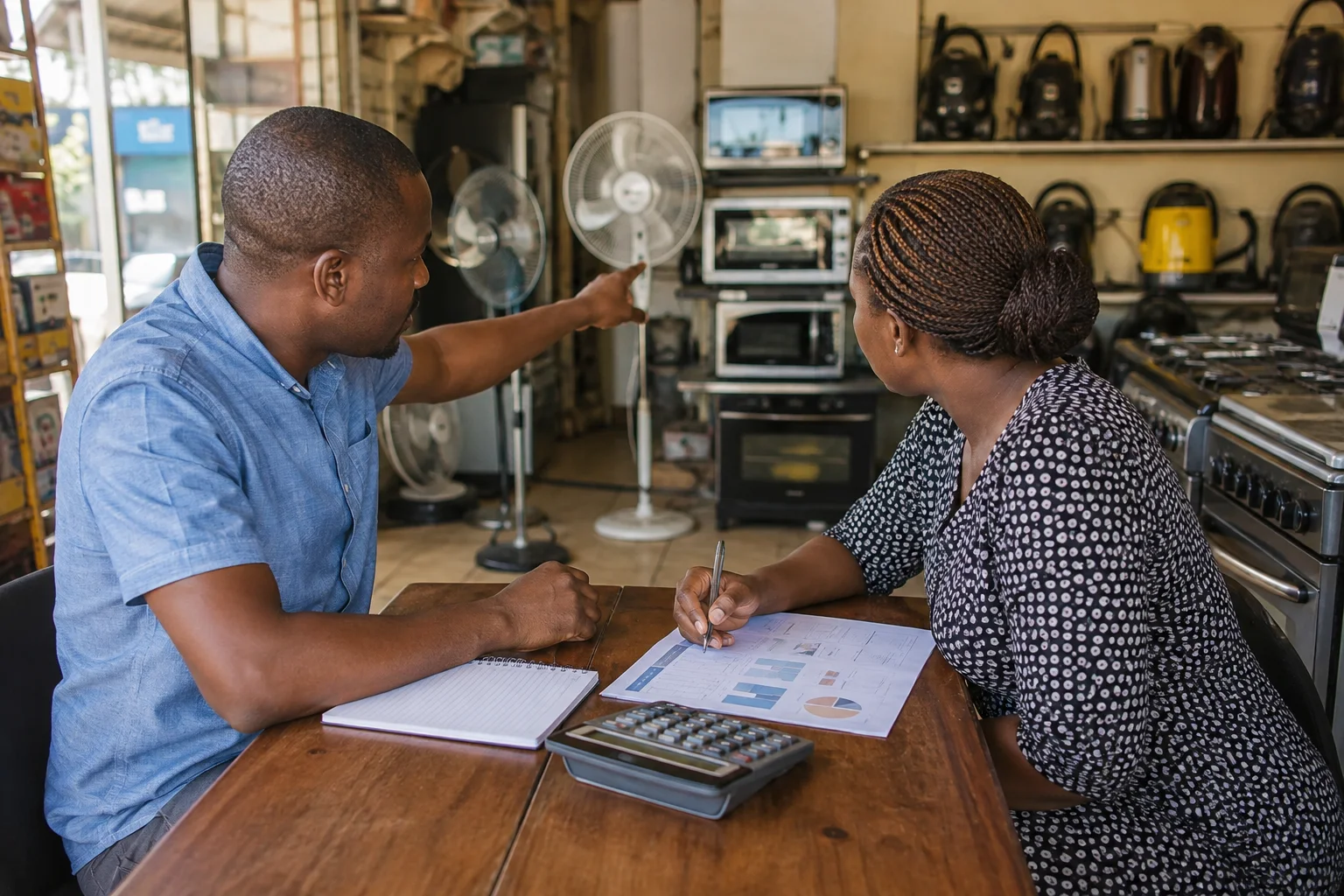
Whether you're selling your business, bringing in a partner, or applying for a bank loan, one question matters above all: how much is your business actually worth?
This guide compares three valuation approaches through worked examples and explains when to involve a professional valuer. The multiples and fee ranges are illustrative planning inputs, not verified Kenyan market rates.
1. Why Business Valuation Matters
Kenyan SME owners increasingly need valuations for:
- Selling the business — partially or wholly
- Attracting investors — angel, venture capital, or private equity
- Bank loans — using business assets as collateral
- Tax compliance and succession planning
- Resolving shareholder disputes or partnership splits
- Estate planning and inheritance
A documented valuation can help you set a negotiation range, but the price ultimately depends on the transaction, buyer and terms.
The worked figures below are hypothetical. Match the multiple to the earnings measure: an EBITDA multiple estimates enterprise value, while a multiple of net profit after interest and tax estimates equity value. To move from enterprise value to equity value, subtract debt and add surplus cash, with other agreed adjustments where relevant. Do not deduct debt a second time from an equity value.
2. The Three Main Valuation Methods
Method 1: Asset-Based Approach (Net Assets)
Calculate the value of the assets, then subtract liabilities to estimate net asset equity value. Book values are a starting point; a valuation may require adjustments to reflect the assets' values on the valuation date.
Formula: Value = Total Assets − Total Liabilities
Best for:
- Asset-heavy businesses (real estate, manufacturing, transport)
- Businesses with low or negative earnings
- Liquidation scenarios
Example: A Nairobi hardware store has assets worth KES 15 million (stock, vehicles, machinery, building) and liabilities of KES 4 million. Under the asset approach, the business is valued at KES 11 million.
Limitation: Doesn't account for future earnings, brand value, or goodwill. Often undervalues service-based businesses.
Method 2: Income Approach (Earnings-Based)
The income approach estimates value from the business’s ability to generate future economic benefits, such as earnings or cash flow. The suitable method depends on the business, evidence and valuation purpose.
Two common variations:
- Discounted Cash Flow (DCF): Forecast cash flows over an explicit period, for example 3–5 years, and account for the value of later cash flows. Discount them at a rate consistent with the cash-flow measure, currency and risk. A 12%–25% range can be used for a sensitivity exercise here; it is not an observed Kenyan market range.
- Earnings Multiplier (Capitalization of Earnings): Estimate maintainable earnings and apply a justified, consistently defined multiple. Use an equity multiple for after-interest, after-tax net profit, or an enterprise-value multiple for EBITDA; these measures are not interchangeable.
Illustrative example: A hypothetical wholesaler in Mombasa earns maintainable net profit after interest and tax of KES 8 million a year. Assume an equity earnings multiple of 8×, equivalent to a 12.5% earnings yield: KES 8,000,000 × 8 = KES 64,000,000 in equity value. The multiple is an assumption, not a Kenyan market finding; do not subtract debt again from this equity result.
Best for: Established SMEs with consistent cash flow, predictable revenue, and investor-ready companies.
Method 3: Market Approach (Comparable Sales)
Compares your business to similar ones that have recently been sold in Kenya. The most intuitive approach — but finding true comparables can be challenging.
Best for: Businesses in active transaction markets (retail, restaurants, franchises).
Illustrative example: A hypothetical chain of three fast-food outlets in Nairobi has EBITDA of KES 12 million. Assuming a 4× EBITDA multiple, the indicated enterprise value is KES 12,000,000 × 4 = KES 48,000,000. Validate the multiple against comparable transactions and adjust for debt, cash and working capital before estimating equity value.
Limitation: Many Kenyan business sales are private with undisclosed terms, making it hard to find accurate comparables.
3. Illustrative Industry Multiples
The ranges below are teaching assumptions for comparing methods, not a verified dataset of Kenyan sale transactions or a market quote. Actual multiples require comparable transactions, consistent earnings definitions and adjustment for debt, cash, working capital, size, risk and control rights.
- Retail & Trading: EBITDA multiple 2×–4×, Revenue multiple 0.3×–0.8×
- Manufacturing: EBITDA multiple 3×–6×, Revenue multiple 0.5×–1.2×
- Technology / SaaS: EBITDA multiple 5×–10×, Revenue multiple 2×–5×
- Hospitality: EBITDA multiple 3×–5×, Revenue multiple 0.8×–1.5×
- Transport & Logistics: EBITDA multiple 2×–4×, Revenue multiple 0.3×–0.6×
- Agribusiness: EBITDA multiple 3×–5×, Revenue multiple 0.5×–1.0×
4. Factors That Increase (or Decrease) Your Value
Even with the right method, these factors can swing your valuation significantly:
- Recurring revenue: Subscriptions, long-term contracts, and renewable leases command higher multiples than one-off sales.
- Customer diversification: If 70% of revenue comes from one client (e.g., a government tender), your valuation drops. Diversification = higher value.
- Management depth: A business that depends entirely on the owner has lower value. Investors pay for systems, not just the founder.
- Location and tenure: Assess customer access, operating costs and the security and terms of the premises lease. A city name or a long lease does not by itself establish a higher multiple.
- Financial records: Reliable, reconciled accounts help a valuer assess earnings and risk. There is no fixed percentage uplift for audited records; the effect depends on the evidence and business.
- Intellectual property: Trademarks, patents, and proprietary processes command premium valuations.
5. Step-by-Step: How to Value Your Business
DIY Approach (For Internal Planning)
- Gather financial data — 3 years of profit & loss statements, balance sheets, and cash flow statements.
- Choose and normalise the earnings measure — For an EV/EBITDA exercise, calculate maintainable EBITDA and explain one-off and owner-pay adjustments. Do not substitute net profit for EBITDA.
- Select a matching multiple — Research comparable transactions on the same earnings basis. The table above is for sensitivity exercises, not a verified market quote.
- Estimate enterprise value — Maintainable EBITDA × a justified EV/EBITDA multiple gives an indicated enterprise value.
- Bridge to equity and test assumptions — Subtract debt, add surplus cash and apply relevant agreed adjustments. Assess how risk and the selected multiple affect the result without counting the same adjustment twice.
Professional Approach (For Funding, Sales, or Legal Purposes)
- Engage a certified valuer — Look for members of ICPAK (Institute of Certified Public Accountants of Kenya) or ISK (Institution of Surveyors of Kenya) with valuation specialisation.
- Provide documentation — 3 years of financial statements, tax returns, asset lists, customer contracts, and ownership structure.
- Site visit and interviews — The valuer will tour your premises and interview key staff.
- Normalisation adjustments — The valuer adjusts profits for non-recurring expenses, owner salaries above market rate, and above/below-market rents.
- Apply valuation methods — Typically a combination of income, market, and asset approaches.
- Receive the report — A detailed document with valuation conclusion, assumptions, and supporting data.
6. Professional Valuation Costs (2026)
What you'll pay for a professional valuation in Kenya:
- Planning illustration: A KES 80,000–200,000 budget is an assumption for planning, not a current provider tariff or verified Kenyan market range. Obtain written quotes for the purpose, scope and reporting basis you need.
- Mid-market business (turnover KES 100M–500M): fee by written quotation
- Large enterprise (turnover KES 500M+): fee by written quotation
Costs vary based on business complexity, number of locations, and the depth of analysis required. Always get a written engagement letter before starting.
7. Common Mistakes to Avoid
- Overvaluing based on hope: Support forecasts with evidence about customers, margins, costs and risk. Future potential can matter, but an unsupported optimistic forecast is a weak basis for a price.
- Ignoring debt: External loans reduce equity value. Your valuation must account for all liabilities.
- Using only one method: Each method gives a different perspective. Use at least two and compare.
- Skipping financial records: Incomplete records make earnings and risk harder to assess. Reliable reconciled accounts help; an audit does not create a fixed or automatic valuation uplift.
- Confusing revenue with profit: KES 50M in revenue with KES 2M profit and KES 20M in revenue with KES 8M profit describe different margins. Revenue alone cannot rank their values; growth, risk, investment needs, debt and the valuation basis also matter.
- Not normalising owner compensation: If owner pay is KES 500,000/month and evidenced replacement pay is KES 200,000, the difference is KES 3.6M a year before tax. A valuer may adjust maintainable pre-tax earnings by that amount, then consider tax effects where an after-tax measure is used.
8. Preparing Your Business for Valuation
If you plan to sell or seek funding within the next 1–2 years, start now:
- Get your books in order — 3 years of clean, audited financial statements are the gold standard.
- Separate personal and business finances — Mixed accounts make valuation harder and reduce credibility.
- Document key processes — A business that runs without the owner is worth more than one that doesn't.
- Diversify your customer base — Reduce dependency on any single client.
- Secure long-term assets — Long-term leases, trademark registrations, and equipment maintenance records all add value.
- Reduce unnecessary expenses — Clean up the P&L before a valuer sees it.
9. Frequently Asked Questions
How much does a business valuation cost in Kenya?
Fees depend on the purpose, complexity, information quality and report scope. Treat any KES 80,000–200,000 or KES 200,000–500,000 budgeting range here as a planning assumption, not a quoted tariff. Obtain written proposals that specify the work, fees, taxes and additional costs.
Can I value my business myself?
For internal planning, yes — use the earnings multiplier method. For funding, sales, or legal purposes, always use a certified professional. Banks and investors require independent valuations.
Which method is best for a small shop or restaurant?
The earnings multiplier (income approach) works well for most retail and food businesses. If you're in an active market with many comparable sales, the market approach can also be useful.
How often should I get a valuation?
At least once every 2–3 years for internal planning. Before any major transaction (sale, investment, loan application), get a fresh professional valuation.
Sources and update record
Updated 26 October 2026: Aligned opening and discovery summaries with the qualifications in the researched article.
Provider and date note: Rates, limits, fees, availability and product terms can change by provider, product and date. Treat figures here as guidance, check the dated first-party source above, and confirm the current schedule before acting.
Stay updated
 Stay updated
Get the next guide in your inbox.